
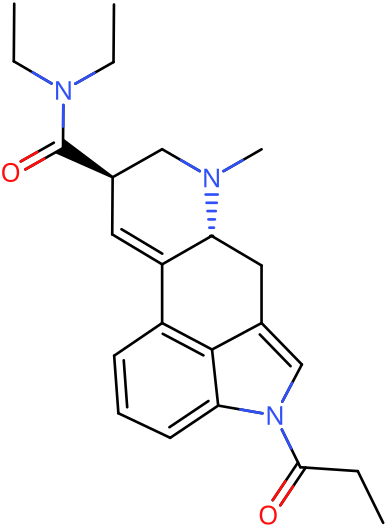
1P-LSD Stats & Data
CCN(CC)C(=O)C1CN(C)C2Cc3cn(C(=O)CC)c4cccc(C2=C1)c34JSMQOVGXBIDBIE-UHFFFAOYSA-NReceptor Profile
Receptor Actions
History & Culture
1P-LSD emerged on the online research chemical market in late 2014 and early 2015, representing the first widely available 1-acylated lysergamide derivative. The compound was first synthesized by Lizard Labs, a Netherlands-based research chemical laboratory that had already established a reputation for producing high-quality novel psychedelics. It quickly became the laboratory's most well-known creation and was subsequently distributed through numerous other vendors worldwide. Prior to its commercial appearance, 1P-LSD had no documented history of human use and does not appear in any academic literature predating its emergence on the grey market. While its synthesis likely occurred in an academic context, the identity of its original discoverer remains unknown. The substance was marketed as a legal alternative to LSD, LSZ, and AL-LAD, typically sold in blotter form and labeled as a research chemical not intended for human consumption. Notably, the strategy of using 1-alkylated lysergamide derivatives to circumvent controlled substance laws was anticipated decades before 1P-LSD's arrival. A 1988 DEA report had foreseen that such structural modifications could be employed to bypass legislation that specifically banned LSD, making 1P-LSD's emergence something of a predicted inevitability within the research chemical community. Upon its release, users quickly recognized that its effects were virtually indistinguishable from those of LSD itself, contributing to its rapid adoption and widespread popularity.
Subjective Effects
Physical
- Spontaneous tactile sensations: The body high of 1P-LSD can be described as proportionally very intense in comparison to its accompanying visual and cognitive effects. It behaves as a euphoric, fast moving, sharp and location specific tingling sensation. For some, it is manifested spontaneously at different unpredictable points throughout the trip, but for most it maintains a steady presence that rises with the onset and hits its limit once the peak has been reached. At moderate to high doses of 1P-LSD, this sensation will usually hit its highest level and become so overwhelming that people may find themselves writhing on the floor in complete pleasure.
- Stimulation: In terms of its effects on the physical energy levels of the tripper, 1P-LSD is usually considered to be very energetic and stimulating without being forced. For example, when taken in any environment it will usually encourage physical activities such as running, walking, climbing or dancing. In comparison, other more commonly used psychedelics such as psilocin are generally sedating and relaxed.
- Nausea: Mild nausea is occasionally reported when consumed in moderate to high dosages and either passes instantly once the tripper has vomited or gradually fades by itself as the peak sets in.
- Tactile enhancement
- Bodily control enhancement
- Increased salivation
- Increased heart rate
- Pupil dilation
Cognitive
In comparison to other psychedelics such as psilocin, LSA and ayahuasca, 1P-LSD is significantly more stimulating and fast paced in terms of the specific style of thought stream produced and contains a large number of potential effects.
- Current mind state enhancement
- Thought acceleration
- Novelty enhancement
- Time distortion
- Analysis enhancement
- Personal bias suppression
- Conceptual thinking
- Memory suppression
- Thought loops
- Feelings of interdependent opposites
- Delusions
- Unity and interconnectedness
- Feelings of self-design
- Spirituality enhancement
- Delineation of thought
Sensory
- Enhancements
- Distortions
- Hallucinations
- Visual drifting: (Melting, Breathing, Morphing and Flowing) - In comparison to other psychedelics, this effect can be described as highly detailed and cartoon-like in its appearance. The distortions are slow and smooth in motion and fleeting in their appearance.
- Tracers
- Depth perception distortions
- Symmetrical texture repetition
- Colour shifting
- Perspective distortions
- Visual acuity enhancement
- Colour enhancement
- Pattern recognition enhancement
1P-LSD is capable of producing a full range of low and high level hallucinatory states in a fashion that is significantly less consistent and reproducible than that of many other commonly used psychedelics.
- Transformations
- Internal hallucinations: Although 1P-LSD is technically capable of producing hallucinatory states in a fashion that is on par with psilocin or DMT in its vividness and intensity, these effects are rarer and more inconsistent in comparison. While traditional psychedelics such as LSA, ayahuasca and mescaline will induce internal hallucinations near consistently at level 5 geometry and above, 1P-LSD will for most simply go straight into Level 8A visual geometry. This lack of consistently induced hallucinatory breakthroughs means that for most, 1P-LSD is not quite as deep of an experience as certain other psychedelics.
Forked from Subjective Effect Documentation by Josie Kins, March 2015. Via dose.wiki (CC0).
Toxicity
PsychonautWikiThe toxicity and long-term health effects of recreational 1P-LSD use have not been studied. This is because 1P-LSD is a research chemical with almost no history of human use. Anecdotal reports suggest that there are no negative health effects attributed to simply trying 1P-LSD by itself, at low to moderate doses, and using it very sparingly (although nothing can be completely guaranteed). Independent research should always be conducted to ensure that a combination of two or more substances is safe before consumption. Based on its similarity to LSD, 1P-LSD is assumed to be physiologically well-tolerated with a extremely low toxicity relative to dose.
Overdose
1P-LSD has no known toxic dose. However, higher doses increase the risk of adverse psychological reactions. These reactions include anxiety, delusions, panic attacks and, more rarely, seizures.
Addiction & dependence
Although no formal studies have been conducted, it is assumed that like LSD itself, 1P-LSD is non-addictive with a low abuse potential. There are no literature reports of successful attempts to train animals to self-administer LSD — an animal model predictive of abuse liability — indicating that it does not have the necessary pharmacology to either initiate or maintain dependence. Likewise, there is virtually no withdrawal syndrome when chronic use of LSD is stopped.
Effect Profile
Curated + 88 ReportsStrong visuals, headspace, auditory effects, and body load
Community Effects
TripSitTolerance & Pharmacokinetics
drugs.wikiTolerance Decay
Rapid within‑session tachyphylaxis; re‑dosing the same day yields little additional effect. Substantial decay by ~7 days; near‑baseline at ~14 days for most, though individual variability exists.
Cross-Tolerances
Demographics
Gender Distribution
Age Distribution
Reports Over Time
Effect Analysis
Erowid + BluelightEffects aggregated from 88 experience reports (57 single-substance Erowid + 31 Bluelight)
Effect Sentiment Distribution
Confidence Distribution
Each bar is the share of reports mentioning the effect; its whisker, and the band on the rows below, is the 95% interval: where the share could plausibly be with other reports of the same kind.
Positive Effects 73
Adverse Effects 51
Show 31 more adverse effects
Dose-Response Correlation
How effect frequency changes across dose levels. Whiskers, and the numbers' hover text, give each figure's 95% interval.
Not drawn, too few reports (a dose tier needs 20): Oral Common (n=14). Why 20?
Dosage Distribution
Dose distribution from experience reports, one dose per report (the first listed). Values above Q3 + 3×IQR are left out as outliers.
Sublingual
Oral
Real-World Dose Distribution
62K DosesFrom 135 individual dose entries. Values above Q3 + 3×IQR are left out as outliers.
Sublingual (n=41)
Oral (n=63)
Common Combinations
Most co-occurring substances, as a share of all 112 reports filed under 1P-LSD; whiskers are 95% intervals
Form / Preparation
Most common forms and preparations, as a share of the 88 reports that give one; whiskers are 95% intervals
Body-Weight Dosing
Dose per kg of body weight, one dose per report (the first listed), from reports giving a weight of 30–250 kg. Values above Q3 + 3×IQR are left out as outliers.
Sublingual
Oral
Unknown
Redose Patterns
Redosing behavior across 90 reports
Legal Status
| Country | Status | Notes |
|---|---|---|
| Australia | Prohibited | Classified as a controlled substance under national drug legislation. |
| Austria | Grey area | Not explicitly scheduled but may fall under the NPSG (Neue-Psychoaktive-Substanzen-Gesetz) as a structural analogue of LSD, making supply for human consumption potentially illegal. |
| Canada | Unscheduled | Not specifically listed in the Controlled Drugs and Substances Act. However, sale or possession for human consumption could potentially be prosecuted under analogue provisions. |
| Croatia | Controlled | Listed as a prohibited substance under national drug control legislation. |
| Czech Republic | Controlled | Classified as a controlled substance since January 1, 2014. |
| Denmark | Illegal | Explicitly named on the list of controlled substances as of August 25, 2015. |
| Estonia | Schedule I (ainete I) | Controlled as a Schedule I substance since June 1, 2017. |
| Finland | Controlled | Classified as a controlled substance since November 15, 2018. |
| France | Prohibited | Listed as a controlled substance under national drug legislation. |
| Germany | NpSG controlled | Regulated under the Neue-psychoaktive-Stoffe-Gesetz (New Psychoactive Substances Act) since July 18, 2019. Production, import for market distribution, administration to others, and trading are criminal offenses. Personal possession is prohibited but not subject to criminal penalty. |
| Italy | Tabella I (Schedule I) | Classified as a Schedule I controlled substance under Italian drug legislation. |
| Japan | Controlled | Listed as a controlled substance under national drug control laws. |
| Latvia | Illegal | Controlled as a structural analogue of LSD following an amendment to drug scheduling that took effect June 1, 2015. Not explicitly named but covered under analogue provisions. |
| Lithuania | Illegal | Explicitly named on the list of controlled substances since September 21, 2015. |
| Norway | Controlled | Classified as a controlled substance since February 14, 2013. |
| Romania | Controlled | Listed as a controlled substance under national drug legislation. |
| Russia | Illegal | Prohibited since 2017 as a derivative of LSD under national drug control laws. |
| Singapore | Class A | Classified as a Class A controlled substance, carrying severe penalties for possession, trafficking, and distribution. |
| Sweden | Illegal | Specifically scheduled following its emergence as a designer drug. Prohibition took effect January 26, 2016. |
| Switzerland | Verzeichnis E | Explicitly named under Verzeichnis E of controlled substances since December 2015. |
| Turkey | Illegal | Prohibited under national drug control legislation since February 2016. |
| United Kingdom | Illegal (Psychoactive Substances Act) | Production, supply, and import prohibited under the Psychoactive Substances Act 2016, which came into effect May 26, 2016. This blanket legislation covers psychoactive substances not specifically exempted. |
| United States | Unscheduled (Analogue Act applies) | Not explicitly scheduled under the Controlled Substances Act. However, as a prodrug of LSD, possession and sale intended for human consumption may be prosecuted under the Federal Analogue Act, which treats substantially similar compounds as Schedule I substances. |
Harm Reduction
drugs.wiki1P‑LSD first appeared circa 2014–2015 and is widely believed to act as a prodrug for LSD: incubation in human serum yields LSD, and subjective time‑course is near‑identical to LSD for most users. Start low because potency equivalence to LSD varies across labs/batches and human data are mixed; community surveys tend to find similar duration and slightly weaker average strength than LSD, but animal HTR potency is lower and inter‑batch variability is large. Blotter dose labels are often imprecise; consider that actual content may deviate ±15–30%. Reagent testing: 1‑acyl lysergamides may show a delayed/weak Ehrlich reaction (pink to light purple over 15–30+ minutes); use a clean ceramic surface, pre‑wet the blotter with a drop of water, and prefer multi‑reagent or laboratory drug checking where available; note that adulteration with tryptamine has been used to fake Ehrlich‑positive results. Redosing the same day is typically inefficient due to rapid 5‑HT2A tolerance; spacing at least 2 weeks between sessions helps restore sensitivity. Avoid mixing with lithium or TCAs due to consistent reports of severe reactions and seizures; if you take prescription psychoactives, consult a clinician. Plan set/setting, have a trusted sober sitter for higher doses, and avoid unsafe environments; impairments can persist into the next day—do not drive or operate machinery until fully baseline. Store blotters airtight, light/heat/oxygen protected (foil, desiccant, cold), to limit degradation and inadvertent hydrolysis to LSD over time. People with a personal or family history of psychosis or bipolar disorder should avoid serotonergic psychedelics due to elevated risk of adverse psychiatric events.
References
Data Sources
Cited References
Additional references
- Drug Users Bible: 1P‑LSD
- TripSit Wiki: LSD (duration, storage, lithium/TCA warning)
- Drugs‑Forum: 1P‑LSD overview (dosage/duration ranges)
- Bluelight: The Big & Dandy 1P‑LSD Thread (user time‑course/administration)
- Erowid: Novel Drug Briefs 2 (1P‑LSD; serum incubation produced LSD)
- Erowid LSD Health (Lithium and TCA warnings; seizure/death case reports)
- TripSit drug combinations (LSD + MAOIs/stimulants/cannabis guidance)
- Bluelight: Biology/Pharmacology & Drugs 101 (LSD half‑life discussion, receptor kinetics)
- Erowid Crew Blog: Reagent pitfalls (tryptamine adulteration faking Ehrlich)