
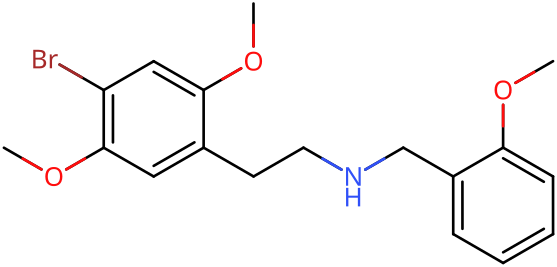
25B-NBOMe Stats & Data
COc1ccccc1CNCCc1cc(OC)c(Br)cc1OCSUXGNJVVBGJEFB-UHFFFAOYSA-NHistory & Culture
25B-NBOMe was first described in the scientific literature by Ralf Heim and colleagues at the Free University of Berlin, with initial findings presented in conference abstracts as early as 1999. The compound was subsequently characterized in more detail through continued research at the institution in the early 2000s. The substance had no documented history of recreational human use until 2010, when it first emerged on the online research chemical market. Its high potency, allowing active doses to be applied to blotter paper similar to LSD, contributed to its rapid adoption among those seeking novel psychoactive substances. This blotter form also led to instances where users mistook 25B-NBOMe for LSD. Independent of its recreational emergence, researchers in Copenhagen developed a carbon-11 labeled version of the compound, designated [11C]Cimbi-36, for use as a positron emission tomography radiotracer. This radioligand was investigated as a potential functional marker of serotonin 2A receptors and as an indicator of serotonin release in living subjects. The radiolabeled compound has since undergone clinical trials for use as a neuroimaging tool in humans.
Subjective Effects
Physical
The physical effects of 25B-NBOMe can be broken down into six components all of which progressively intensify proportional to dosage.
- Sublingual numbing: Assuming the substance has been taken sublingually, the very first physical effect which a person will notice immediately after sublingual absorption is a strong, unpleasant metallic chemical taste. This is accompanied by a very obvious feeling of general numbness of the tongue and mouth which can stay for up to an hour after the blotter paper has been consumed. This is the key difference when it comes to determining whether your blotter paper contains LSD or one of the NBOMe series.
- Spontaneous tactile sensations: The body high itself can be described as a generally mild, all-encompassing, soft but euphoric tingling sensation. This tingling sensation is also accompanied by spontaneous rushes of euphoria that become longer and more drawn out proportional to the dosage consumed.
- Decreased bodily weight: In terms of the body's perceived weight, this substance consistently leaves people feeling extremely light, often to the point of total weightlessness.
- Stimulation: In terms of its effects on the physical energy levels of the tripper, 25B-NBOMe is usually considered to be energetic and stimulating, but it can be considered less stimulating when compared to 25I-NBOMe. For most people, this substance induces a unique type of physical stimulation which can be described as feeling extremely energetic but in a way which does not force the tripper to move unless they genuinely choose to do so. For others however, the stimulation can be quite uncontrollable, occasionally resulting in bodily shakes and a grinding of the teeth comparable to that of MDMA and traditional stimulants such as amphetamine, but this is manifested much less consistently when compared to 25I-NBOMe.
- Vasoconstriction: It is worth noting that an undetermined percentage of people who experiment with this drug will experience negative physical side effects, such as a temporary difficulty in urinating and vasoconstriction. This is defined as the narrowing of the blood vessels resulting from contraction of the muscular wall of the vessels and is triggered through the way in which 25B-NBOMe's target receptor (5-HT2A) modulates both vasoconstriction and vasodilation among its many other functions.
- Nausea: As the tripper begins to come up, nausea is not uncommon and can sometimes result in initial vomiting, but passes once this has either happened or the trip begins to fully set in. In comparison to other psychedelics such as psilocin, LSD, 2C-E and 2C-I, this could actually be very considered very mild in its intensity.
Cognitive
The head space of 25B-NBOMe is described by many as remarkably light and underwhelming in comparison to the classical psychedelics. It is not uncommon for people to report feeling that their thought stream has maintained general normality in its specific style throughout low to moderate dosages. At high dosages however, mild to overwhelming cognitive alterations become present.
- Introspection: This component is consistently manifested only in the context of a non-social setting in which the user is alone.
- Increased empathy, love and sociability: The entactogenic effects range from mild to powerful, but are inconsistently manifested. Entactogenic effects for people who try this substance usually become prominent in the presence of others. These feelings of increased sociability, love and empathy do not seem to be quite as strong or profound as those found within other entactogens (such as MDMA, 2C-B and AMT).
- Acceleration of thought
- Time distortion
- Feelings of fascination, importance and awe
- Conceptual thinking
- Connectivity of thought
- Enhancement of current mind state
- Removal of cultural filter
- Ego suppression, loss and death
Sensory
- Enhancements
- Distortions
- Hallucinations
- Visual drifting: (Melting, Flowing, Breathing and morphing) - In comparison to other psychedelics, this effect can be described as highly detailed, slow and smooth in motion, static in their appearance and unrealistic/cartoon-like in style.
- Tracers
- After images
- Texture repetition
- Colour shifting
- Scenery slicing
- Increased visual acuity
- Enhancement of colour
- Enhanced pattern recognition
25B-NBOMe is capable of producing a full range of hallucinatory states within the level 1 - 3 range extremely consistently. However, level 4 hallucinatory breakthroughs are reported but very uncommon and inconsistent in comparison to other more commonly used psychedelics such as psilocin, 2C-E and DMT.
- External hallucinations
- Internal hallucinations: This particular effect commonly contains hallucinations with scenarios, settings, concepts and autonomous entity contact. They are more common within dark environments and can be described as internal in their manifestation, lucid in believability, interactive in style and almost exclusively of religious, spiritual, mystical or a transcendental nature in their overall theme.
Forked from Subjective Effect Documentation by Josie Kins, April 2014. Via dose.wiki (CC0).
Toxicity
PsychonautWiki25B-NBOMe is a relatively new substance, and little is known about its pharmacological risks or its interaction with other substances. The lethal dosage has not yet been determined. One case has been reported on where 25B-NBOMe was identified as the cause of death for a 17-year-old boy. It is advised that due to 25B-NBOMe's extreme potency it should not be insufflated as this method of administration is potentially fatal at heavy dosages. 25B-NBOMe has been used in clinical trials with an evaluation dose for safety consideration to humans of only 1 microgram; Such a dose is 300× lower than the dose expected to be hallucinogenic to humans and it is expected that recreational use would greatly exceed doses determined to be safe to humans.
Effect Profile
Curated + 24 ReportsStrong visuals, headspace, auditory effects, and body load
Duration Timeline
BluelightCommunity Effects
TripSitTolerance & Pharmacokinetics
drugs.wikiTolerance Decay
Cross-Tolerances
Demographics
Gender Distribution
Age Distribution
Reports Over Time
Effect Analysis
Erowid + BluelightEffects aggregated from 24 experience reports (17 single-substance Erowid + 7 Bluelight)
Effect Sentiment Distribution
Confidence Distribution
Each bar is the share of reports mentioning the effect; its whisker, and the band on the rows below, is the 95% interval: where the share could plausibly be with other reports of the same kind.
Rows resting on fewer than 20 reports show a count (“3 of 7”) instead of a bar. Why 20?
Positive Effects 30
Adverse Effects 25
Show 5 more adverse effects
Real-World Dose Distribution
62K DosesFrom 35 individual dose entries. Values above Q3 + 3×IQR are left out as outliers.
Sublingual (n=13)
Common Combinations
Most co-occurring substances, as a share of all 33 reports filed under 25B-NBOMe; whiskers are 95% intervals
Form / Preparation
Most common forms and preparations, as a share of the 31 reports that give one; whiskers are 95% intervals
Body-Weight Dosing
Dose per kg of body weight, one dose per report (the first listed), from reports giving a weight of 30–250 kg. Values above Q3 + 3×IQR are left out as outliers.
Redose Patterns
Redosing behavior across 31 reports
Legal Status
| Country | Status | Notes |
|---|---|---|
| Austria | Illegal (SMG) | Prohibited under the Suchtmittelgesetz (Narcotic Substances Act) since June 26, 2019. Possession, production, and sale are illegal. |
| Brazil | Illegal (Portaria SVS/MS nº 344) | Listed as a controlled substance under Portaria SVS/MS nº 344. Possession, production, and sale are prohibited. |
| Canada | Schedule III (CDSA) | Controlled under Schedule III of the Controlled Drugs and Substances Act as of October 31, 2016. Classified as a derivative of 2,5-dimethoxyphenethylamine. |
| China | Controlled substance | Designated as a controlled substance as of October 2015 under national drug control regulations. |
| Czech Republic | Banned | Prohibited substance under Czech drug legislation. |
| Finland | Scheduled narcotic | Listed in the government decree on substances, preparations, and plants considered to be narcotic drugs. |
| Germany | Anlage I BtMG | Controlled under Anlage I of the Betäubungsmittelgesetz (Narcotics Act) since December 13, 2014. Manufacturing, possession, import, export, purchase, sale, procurement, and dispensing without license are prohibited. |
| Italy | Schedule I | Classified as a Schedule 1 controlled substance under Italian drug legislation. |
| Japan | Narcotic | Designated as a narcotic drug under Japanese law, effective November 1, 2015. |
| Latvia | Schedule I | Classified as a Schedule I controlled substance under Latvian drug control legislation. |
| New Zealand | Schedule 2 | Controlled as a Schedule 2 substance under the Misuse of Drugs Act. |
| Russia | Banned | Prohibited as a narcotic drug since May 5, 2015 under Russian federal drug control legislation. |
| Sweden | Schedule I | Added to Schedule I (substances normally without medical use) as of August 1, 2013, published by the Medical Products Agency in regulation LVFS 2013:15. |
| Switzerland | Controlled (Verzeichnis D) | Specifically named as a controlled substance under Verzeichnis D of Swiss narcotics legislation. |
| Turkey | Illegal | Classified as a controlled drug. Possession, production, supply, and import are prohibited. |
| United Kingdom | Class A | Controlled as a Class A substance under the Misuse of Drugs Act 1971 through the N-benzylphenethylamine catch-all clause. Class A carries the most severe penalties for possession and supply. |
| United States | Schedule I | Placed in Schedule I of the Controlled Substances Act by the DEA in November 2013 using emergency scheduling powers, alongside 25I-NBOMe and 25C-NBOMe. Manufacturing, purchase, possession, processing, and distribution are prohibited. |