
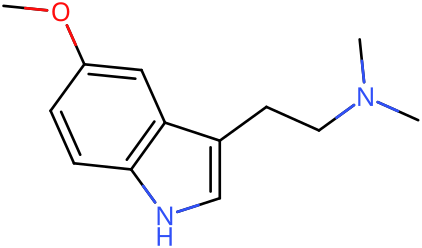
5-MeO-DMT Stats & Data
ZSTKHSQDNIGFLM-UHFFFAOYSA-NPharmacology
DrugBankDescription
5-methoxy-N,N-dimethyltryptamine (5-MeO-DMT) is a tryptamine with psychedelic properties. It is found in a wide variety of plant species, and a single psychoactive toad species, the Colorado River toad. This drug, as well as dimethyltryptamine and bufotenin, have been registered to be used in South America in religious and spiritual rituals.
Receptor Profile
Receptor Actions
Measured Affinities
Guide to PHARMACOLOGYMeasured binding and functional data for 5-MeO-DMT, curated by the IUPHAR/BPS Guide to PHARMACOLOGY. Each row cites the paper it came from. Lower concentrations mean tighter binding — a value in the sub-nanomolar range indicates a very potent interaction.
| Target | Action | Measure | Value | Concentration | Species | Source |
|---|---|---|---|---|---|---|
| 5-HT1F receptor HTR1F | Full agonist | pKi | 7.4 | 39.81 nM | Human | PMID 8380639 |
| 5-HT6 receptor Htr6 | Full agonist | pKi | 6.9 | 125.89 nM | Rat | PMID 9798944 |
| 5-HT2C receptor HTR2C | Full agonist | pKi | — | — | Human | PMID 10217294 |
| 5-HT7 receptor Htr7 | Full agonist | pKi | — | — | Rat | PMID 8394362 |
| 5-ht1e receptor HTR1E | Full agonist | pKi | — | — | Human | — |
Reading this. pKi, pEC50 and pIC50 are negative log molar values, so a higher number means a tighter interaction; the concentration column converts them for you. Values from non-human species are laboratory measurements and do not translate directly to human effect. Receptor affinity is not a dose — it describes what a molecule binds, not how much of it is safe to take.
Receptor data from the IUPHAR/BPS Guide to PHARMACOLOGY (v2026.2), licensed CC BY-SA 4.0. Matched to this substance by InChIKey.
History & Culture
8th century–present
5-MeO-DMT has a lengthy history of human use spanning over a millennium. Archaeological evidence from a burial site in Northern Chile, dated to approximately the 8th century A.D., revealed snuffing paraphernalia alongside traces of N,N-DMT, 5-MeO-DMT, and bufotenine. Additional archaeological sites from the same period have uncovered seeds from Anadenanthera species known to contain the compound. The substance appears as a common constituent in numerous plant species and has been employed traditionally in various psychoactive preparations across South America and the Caribbean. Indigenous groups have utilized it in intranasal snuffs including Yopo, prepared from Anadenanthera colubrina seeds, and Epena, derived from Virola sap. It has also been incorporated as an admixture in certain ayahuasca-type brews. In the early 1950s, researchers identified 5-MeO-DMT as one of the primary psychoactive components in cohoba snuffs used by peoples of the northern Amazon basin.
1936–1959
The compound was first synthesized in 1936 by Japanese chemists Toshio Hoshino and Kenya Shimodaira. Over two decades later, in 1959, it was isolated and identified as one of the psychoactive constituents of Anadenanthera peregrina seeds used in the preparation of Yopo snuff. While 5-MeO-DMT was initially believed to be a major contributor to the psychoactive properties of such snuffs, subsequent research has suggested this is unlikely due to its limited or sometimes negligible presence in the seeds, which instead appear to derive their effects primarily from bufotenine.
1968–present
The first published report identifying toad venom as a natural source of 5-MeO-DMT appeared in 1968. The Colorado River toad (Incilius alvarius, also known as Bufo alvarius) was found to produce venom containing concentrations of up to 15% 5-MeO-DMT. This discovery established the species as the only known psychoactive toad and has since led to its venom becoming a sought-after source of the compound.
1980s–present
Recreational and non-traditional use of 5-MeO-DMT expanded throughout the 1980s and 1990s. Alexander Shulgin documented the synthesis and psychoactive effects of the compound in his 1997 book TiHKAL ("Tryptamines I Have Known and Loved"), which also described the use of Colorado River toad venom. In contemporary times, the substance is primarily obtained in its pure synthetic form through online research chemical vendors. Recent studies have investigated its capacity to induce mystical experiences, and there is growing scientific interest in exploring potential therapeutic applications.
Subjective Effects
In comparison to its often relatively mild accompanying cognitive and visual effects, 5-MeO-DMT seems to have by far the most proportionally intense and overwhelming physical sensations found within the known psychedelic experience.
Physical
The physical effects of 5-MeO-DMT can be broken down into ten components all of which progressively intensify proportional to dosage.
- Enhancement of tactile sensations: This particular component is perhaps the most overwhelming sensation within the entirety of the 5-MeO-DMT experience. It increases the intensity of tactile sensations to such an overwhelming extent that it induces a sustained and repeatable full body orgasm within every nerve ending across the entire body. The experience of this results in the perception of having a difficulty sustaining the act of breathing. It is worth noting, however, that this is not a genuine or dangerous experience of respiratory depression and is perfectly safe.
- Physical euphoria
- Nausea
- Increased bodily control
- Loss of motor control
- Bodily pressures
- Skin flushing
- Changes in gravity
- Loss of temperature regulation
- Increased bodily weight
Cognitive
- Enhancement of current mind state
- Mindfulness
- Conceptual thinking
- Connectivity of thought
- Anxiety
- Time distortion
- Direct communication with the subconscious
- States of unity and interconnectedness
- Ego suppression, loss and death
- Delusions
- Amnesia
Sensory
In comparison to its consistently overwhelming and intense accompanying cognitive and physical effects, 5-MeO-DMT seems to have some of the most proportionally underwhelming visual effects found within the known psychedelic experience.
- Enhancements
- Distortions
- Hallucinations
- Colour shifting
- Visual drifting: (Morphing, Breathing, Melting, Flowing) - In comparison to other psychedelics, this effect can be described as identical to DMT in its style, highly detailed, slow and smooth in motion and static in appearance.
- Visual acuity enhancement and suppression: 5-MeO-DMT is equally capable of both decreasing and increasing visual acuity. The outcome of which effect will manifest seems to be chosen almost entirely at random and is largely setting dependent.
- Colour enhancement
Forked from Subjective Effect Documentation by Josie Kins, September 2014. Via dose.wiki (CC0).
Toxicity
PsychonautWikiThe toxicity and long-term health effects of recreational 5-MeO-DMT do not seem to have been studied in any scientific context and the exact toxic dose is unknown. This is because 5-MeO-DMT has a limited history of documented human usage. Anecdotal evidence suggests that there are unlikely to be any negative health effects attributed to simply trying it by itself at low to moderate doses and using it very sparingly (but nothing can be completely guaranteed). Independent research should always be done to ensure that a combination of two or more substances is safe before consumption. It is strongly recommended that one use harm reduction practices when using this substance.
Addiction & dependence
Like other serotonergic psychedelics, 5-MeO-DMT is considered to be non-addictive with a low abuse potential. There are no literature reports of successful attempts to train animals to self-administer 5-MeO-DMT — an animal model predictive of abuse liability — indicating that it does not have the necessary pharmacology to either initiate or maintain dependence. Tolerance to the effects of 5-MeO-DMT is built almost immediately after ingestion.
Effect Profile
Curated + 325 ReportsStrong visuals, headspace, auditory effects, and body load
Duration Timeline
BluelightCommunity Effects
TripSitTolerance & Pharmacokinetics
drugs.wikiTolerance Decay
Users frequently report marked acute tolerance if re-dosed within the same session; effects are often blunted or dysphoric. Cross‑tolerance with other serotonergic psychedelics is plausible via 5‑HT2A down‑regulation, but quantitative data are limited; estimates here are conservative and anecdotal.
Cross-Tolerances
Demographics
Gender Distribution
Age Distribution
Reports Over Time
Effect Analysis
Erowid + BluelightEffects aggregated from 317 experience reports (267 single-substance Erowid + 58 Bluelight)
Effect Sentiment Distribution
Confidence Distribution
Each bar is the share of reports mentioning the effect; its whisker, and the band on the rows below, is the 95% interval: where the share could plausibly be with other reports of the same kind.
Positive Effects 59
Adverse Effects 53
Show 30 more adverse effects
Dose-Response Correlation
How effect frequency changes across dose levels. Whiskers, and the numbers' hover text, give each figure's 95% interval.
Not drawn, too few reports (a dose tier needs 20): Insufflated Common (n=18). Why 20?
View data table
| Effect | Common (n=35) | Strong (n=26) | Heavy (n=30) |
|---|---|---|---|
| Anxiety | 62.9% (95% interval 46 to 77 percent) | 61.5% (95% interval 42 to 78 percent) | 76.7% (95% interval 59 to 88 percent) |
| Visual Distortions | 54.3% (95% interval 38 to 70 percent) | 53.8% (95% interval 36 to 71 percent) | 50.0% (95% interval 33 to 67 percent) |
| Euphoria | 45.7% (95% interval 30 to 62 percent) | 38.5% (95% interval 22 to 58 percent) | 46.7% (95% interval 30 to 64 percent) |
| Empathy | 40.0% (95% interval 26 to 56 percent) | 26.9% (95% interval 14 to 46 percent) | 26.7% (95% interval 14 to 44 percent) |
| Stimulation | 31.4% (95% interval 19 to 48 percent) | 38.5% (95% interval 22 to 58 percent) | 33.3% (95% interval 19 to 51 percent) |
| Auditory Effects | 28.6% (95% interval 16 to 45 percent) | 38.5% (95% interval 22 to 58 percent) | 16.7% (95% interval 7 to 34 percent) |
| Color Enhancement | 22.9% (95% interval 12 to 39 percent) | 38.5% (95% interval 22 to 58 percent) | 30.0% (95% interval 17 to 48 percent) |
| Confusion | 28.6% (95% interval 16 to 45 percent) | 30.8% (95% interval 16 to 50 percent) | 13.3% (95% interval 5 to 30 percent) |
| Music Enhancement | 25.7% (95% interval 14 to 42 percent) | 30.8% (95% interval 16 to 50 percent) | 13.3% (95% interval 5 to 30 percent) |
| Introspection | 22.9% (95% interval 12 to 39 percent) | 30.8% (95% interval 16 to 50 percent) | 10.0% (95% interval 4 to 26 percent) |
| Nausea | 28.6% (95% interval 16 to 45 percent) | 19.2% (95% interval 8 to 38 percent) | 20.0% (95% interval 10 to 37 percent) |
| Dissociation | 25.7% (95% interval 14 to 42 percent) | 26.9% (95% interval 14 to 46 percent) | 26.7% (95% interval 14 to 44 percent) |
| Hospital | 5.7% (95% interval 2 to 19 percent) | 15.4% (95% interval 6 to 34 percent) | 26.7% (95% interval 14 to 44 percent) |
| Increased Heart Rate | 25.7% (95% interval 14 to 42 percent) | 11.5% (95% interval 4 to 29 percent) | 6.7% (95% interval 2 to 21 percent) |
| Ego Dissolution | 22.9% (95% interval 12 to 39 percent) | 11.5% (95% interval 4 to 29 percent) | 23.3% (95% interval 12 to 41 percent) |
Subjective Effect Ontology
Experience ReportsStructured effect tags extracted from 424 Erowid & Bluelight experience reports using a controlled vocabulary of 220+ canonical effects across 15 domains.
Auditory
Cognitive
Emotional
Gastrointestinal
Motor
Tactile
Visual
Dose–Effect Mapping
Experience ReportsHow reported effects shift across dose tiers, based on 267 single-substance experience reports. The shaded band on each bar is its 95% interval. An arrow (↑ ↓) marks a change between the lowest and highest tier that count an effect only when the gap is bigger than chance would explain; ~ means no clear change. How changes are called
Not drawn, too few reports (a dose tier needs 20): Insufflated Common (n=18). Why 20?
| Effect | Common (n=35) | Strong (n=26) | Heavy (n=30) | Change with dose |
|---|---|---|---|---|
| anxiety | (no clear change: +14 points from Common to Heavy, 95% interval −9 to +34) | |||
| visual distortions | (no clear change: −4 points from Common to Heavy, 95% interval −27 to +19) | |||
| euphoria | (no clear change: +1 points from Common to Heavy, 95% interval −22 to +24) | |||
| empathy | (no clear change: −13 points from Common to Heavy, 95% interval −34 to +10) | |||
| stimulation | (no clear change: +2 points from Common to Heavy, 95% interval −20 to +24) | |||
| auditory effects | (no clear change: −12 points from Common to Heavy, 95% interval −31 to +9) | |||
| color enhancement | (no clear change: +7 points from Common to Heavy, 95% interval −14 to +28) | |||
| confusion | (no clear change: −15 points from Common to Heavy, 95% interval −34 to +5) | |||
| music enhancement | (no clear change: −12 points from Common to Heavy, 95% interval −31 to +8) | |||
| introspection | (no clear change: −13 points from Common to Heavy, 95% interval −30 to +6) | |||
| nausea | (no clear change: −9 points from Common to Heavy, 95% interval −28 to +13) | |||
| dissociation | (no clear change: +1 points from Common to Heavy, 95% interval −20 to +22) | |||
| hospital | (+21 points from Common to Heavy, 95% interval +3 to +39) | |||
| increased heart rate | (−19 points from Common to Heavy, 95% interval −36 to −0.4) | |||
| ego dissolution | (no clear change: +0.4 points from Common to Heavy, 95% interval −19 to +21) | |||
| closed-eye visuals | (no clear change: +3 points from Common to Heavy, 95% interval −16 to +22) | |||
| tactile enhancement | — | (no clear change: −6 points from Strong to Heavy, 95% interval −26 to +14) | ||
| focus enhancement | — | (no clear change: −9 points from Common to Strong, 95% interval −26 to +9) | ||
| body high | — | (no clear change: +4 points from Common to Strong, 95% interval −13 to +23) | ||
| memory suppression | — | (no clear change: −9 points from Strong to Heavy, 95% interval −28 to +9) |
Showing top 20 of 30 effects
Risk Escalation
Sentiment AnalysisAverage frequency of positive vs adverse effects across dose tiers. A tier's average is the mean share of the effects counted in that tier, not a share of reports, and its range is a deliberately wide 95% interval. A tier with more reports also counts rarer effects, which pulls its average down, so compare single effects in the breakdown rather than these averages. There, the shaded band on each bar is its 95% interval, and Change is marked up or down only when the gap between two tiers is bigger than chance would explain. How changes are called
View effect breakdown
Adverse Effects
| Effect | Common (n=35) | Strong (n=26) | Heavy (n=30) | Change |
|---|---|---|---|---|
| Anxiety | no clear change (no clear change: +14 points from Common to Heavy, 95% interval −9 to +34) | |||
| Confusion | no clear change (no clear change: −15 points from Common to Heavy, 95% interval −34 to +5) | |||
| Nausea | no clear change (no clear change: −9 points from Common to Heavy, 95% interval −28 to +13) | |||
| Increased Heart Rate | −19 pts (−19 points from Common to Heavy, 95% interval −36 to −0.4) | |||
| Memory Suppression | — | no clear change (no clear change: −9 points from Strong to Heavy, 95% interval −28 to +9) | ||
| Motor Impairment | no clear change (no clear change: −5 points from Common to Heavy, 95% interval −20 to +11) | |||
| Sweating | no clear change (no clear change: +4 points from Common to Heavy, 95% interval −10 to +20) | |||
| Jaw Clenching | — | no clear change (no clear change: +4 points from Common to Heavy, 95% interval −10 to +20) | ||
| Seizure | — | — | — | |
| Pupil Dilation | — | — | — | |
| Headache | — | — | — |
Positive Effects
| Effect | Common (n=35) | Strong (n=26) | Heavy (n=30) | Change |
|---|---|---|---|---|
| Visual Distortions | no clear change (no clear change: −4 points from Common to Heavy, 95% interval −27 to +19) | |||
| Euphoria | no clear change (no clear change: +1 points from Common to Heavy, 95% interval −22 to +24) | |||
| Empathy | no clear change (no clear change: −13 points from Common to Heavy, 95% interval −34 to +10) | |||
| Stimulation | no clear change (no clear change: +2 points from Common to Heavy, 95% interval −20 to +24) | |||
| Color Enhancement | no clear change (no clear change: +7 points from Common to Heavy, 95% interval −14 to +28) | |||
| Music Enhancement | no clear change (no clear change: −12 points from Common to Heavy, 95% interval −31 to +8) | |||
| Introspection | no clear change (no clear change: −13 points from Common to Heavy, 95% interval −30 to +6) | |||
| Closed-Eye Visuals | no clear change (no clear change: +3 points from Common to Heavy, 95% interval −16 to +22) | |||
| Tactile Enhancement | — | no clear change (no clear change: −6 points from Strong to Heavy, 95% interval −26 to +14) | ||
| Focus Enhancement | — | no clear change (no clear change: −9 points from Common to Strong, 95% interval −26 to +9) | ||
| Body High | — | no clear change (no clear change: +4 points from Common to Strong, 95% interval −13 to +23) | ||
| Open-Eye Visuals | — | — | — | |
| Creativity Enhancement | — | — | — |
Dosage Distribution
Dose distribution from experience reports, one dose per report (the first listed). Values above Q3 + 3×IQR are left out as outliers.
Smoked
Insufflated
Real-World Dose Distribution
62K DosesFrom 351 individual dose entries. Values above Q3 + 3×IQR are left out as outliers.
Intramuscular (n=5)
Smoked (n=199)
Insufflated (n=73)
Intravenous (n=5)
Oral (n=7)
Common Combinations
Most co-occurring substances, as a share of all 374 reports filed under 5-MeO-DMT; whiskers are 95% intervals
Form / Preparation
Most common forms and preparations, as a share of the 291 reports that give one; whiskers are 95% intervals
Body-Weight Dosing
Dose per kg of body weight, one dose per report (the first listed), from reports giving a weight of 30–250 kg. Values above Q3 + 3×IQR are left out as outliers.
Smoked
Insufflated
Redose Patterns
Redosing behavior across 301 reports
Legal Status
| Country | Status | Notes |
|---|---|---|
| Australia | Schedule 9 | Classified as a prohibited substance under the Poisons Standard as a structural analog of N,N-dimethyltryptamine (DMT). No therapeutic use is recognized. |
| Austria | Illegal (SMG) | Prohibited under the Suchtmittelgesetz (Narcotics Act) as an ether of N,N-DMT. Possession, production, and sale are illegal without authorization. |
| Belgium | Uncontrolled (unconfirmed) | Reportedly not explicitly controlled under Belgian law, although DMT itself is scheduled under the 1971 UN Convention. This status remains unconfirmed. |
| Brazil | Illegal | Possession, production, and sale are prohibited under Portaria SVS/MS nº 344. |
| Canada | Unscheduled | Not scheduled under the Controlled Drugs and Substances Act. Possession and sale are not specifically prohibited under federal drug law. |
| China | Controlled | Classified as a controlled substance effective October 2015 under national drug regulations. |
| Czech Republic | Legal | Not listed in Government Regulation n. 463/2013 (Nařízení vlády č. 463/2013 Sb), making it legal to possess and sell. |
| Denmark | Restricted | Legally restricted to medical or scientific purposes since December 2004. General possession and sale are prohibited. |
| Finland | Illegal | Banned in December 2014 under a government regulation that prohibited over 100 psychoactive chemicals. |
| Germany | Anlage I BtMG | Listed in Schedule I of the Betäubungsmittelgesetz (Narcotics Act) since 2000. Manufacturing, possession, import, export, purchase, sale, and distribution without a license are prohibited. |
| Greece | Controlled | Became a controlled substance on February 18, 2003, as recorded in the EU Legal Database. |
| Japan | Designated Substance | Controlled as a Shitei-Yakubutsu (Designated Substance) under the Pharmaceutical Affairs Law. Possession and sale are illegal without authorization. |
| Latvia | Schedule I | Listed as a Schedule I controlled substance under national drug legislation. Possession and distribution are prohibited. |
| Netherlands | Ambiguous (potentially List I) | While not explicitly named in the Opium List, it may be considered a List I controlled substance as an ether of bufotenin. Despite this legal ambiguity, it reportedly remains available through online research chemical vendors. |
| New Zealand | Class A (Schedule I) | Classified as a Class A controlled substance, carrying the most severe legal penalties for possession and distribution in New Zealand. |
| Romania | Illegal (Analogue Act) | Prohibited under the controlled substance analogue act since February 2010. Production and sale are illegal. |
| Russia | Controlled | Became a controlled substance in October 2011 under federal drug legislation. |
| South Africa | Ambiguous | Not explicitly listed under the Drug and Drug Trafficking Act No. 140 of 1992. However, it could potentially be controlled as an ether of bufotenin or DMT, since ethers and esters of listed substances are also considered controlled. |
| Sweden | Health Hazard | Classified under the Act on the Prohibition of Certain Goods Dangerous to Health (Lagen om förbud mot vissa hälsofarliga varor) via regulation SFS 2004:696 effective October 1, 2004. Sale and possession are prohibited. |
| Switzerland | Controlled (Verzeichnis E) | Specifically named as a controlled substance in Verzeichnis E (Schedule E) of Swiss narcotics legislation. |
| Turkey | Illegal | Classified as a controlled drug since December 2013. Possession, production, supply, and import are prohibited. |
| Ukraine | Controlled | Listed as a controlled substance under Ukrainian drug legislation. |
| United Kingdom | Class A (Schedule I) | Controlled under the Misuse of Drugs Act 1971 as a Class A drug because it is an ether of 5-HO-DMT (bufotenin), which falls under the tryptamine catch-all clause. Buying or possessing without a license is illegal. |
| United States | Schedule I | Added to Schedule I of the Controlled Substances Act effective January 19, 2011. Manufacturing, buying, possessing, or distributing without a DEA license is illegal. Several states including Florida, Louisiana, Nebraska, Oklahoma, and South Dakota had independently scheduled it prior to federal action. |
Harm Reduction
drugs.wiki5‑MeO‑DMT is extremely potent and fast‑acting; vapourized breakthrough effects can occur from as little as 3–5 mg in some users, so pre-measuring on a 0.001 g scale and avoiding “eyeballing” is critical for safety. Acute, short-lived non‑responsiveness and loss of motor control are frequently reported above ~8–10 mg smoked/vaporized or ~15–20 mg insufflated; a sober sitter and a clear, padded space reduce injury risk during the 3–10 minute peak. Combining 5‑MeO‑DMT with MAO inhibitors (harmala alkaloids or pharmaceutical MAOIs) greatly elevates systemic 5‑MeO‑DMT and bufotenine exposure and has been implicated in severe toxicity; avoid this combination entirely. Serotonergic medications and agents (e.g., SSRIs/SNRIs, MDMA, tramadol, DXM, linezolid, 5‑HTP) can raise the risk of serotonin syndrome; spacing and medical advice are prudent if prescribed such drugs. Depressants like alcohol, opioids, or benzodiazepines add sedation and aspiration risk during peak non‑responsiveness; at least one fatality following insufflation involved concurrent heavy alcohol use. Nasal use is better suited to salt forms (HCl/fumarate); freebase burns and absorbs poorly, and onset is slower with a more extended after‑period. Oral 5‑MeO‑DMT is generally inactive without MAO‑A inhibition; because MAOIs substantially increase risk, oral/“pharmahuasca” approaches with 5‑MeO‑DMT are not recommended. “Bufo”/toad secretion contains additional, variably present compounds and has inconsistent potency; synthetic 5‑MeO‑DMT permits accurate dosing and avoids wildlife/ethical harms. Start with the lowest end of dose ranges, use a temperature‑controlled vaporization method (avoid direct flame charring), and pre‑arrange recovery position guidance with a sitter in case of vomiting. Individuals with cardiovascular disease, seizure history, or unstable psychiatric conditions should avoid use; prolonged anxiety or destabilization can occur in some users and may require integration support. Expect rapid tolerance within a session; redosing during the peak typically produces diminished or dysphoric effects, and spacing sessions by at least several days is prudent.
References
Data Sources
Cited References
- Barsuglia et al. 2018 - Mystical Experiences with 5-MeO-DMT
- Davis et al. 2018 - Epidemiology of 5-MeO-DMT Use
- Ermakova et al. 2022 - Narrative Synthesis of Research with 5-MeO-DMT
- Ott 2001 - Human Intranasal, Sublingual and Oral Pharmacology
- Reckweg et al. 2022 - Clinical Pharmacology of 5-MeO-DMT
- Shen et al. 2010 - Metabolism, Pharmacokinetics and Drug Interactions
- Shulgin & Shulgin 1997 - TiHKAL Entry #38
- Third Wave: 5-MeO-DMT Guide
- DrugBank: 5-MeO-DMT
- DrugBank Article: 5-MeO-DMT
Additional references
- Erowid 5‑MeO‑DMT Basics (dose, onset, duration, ROAs)
- Erowid 5‑MeO‑DMT Health (MAOI contraindication, non‑responsiveness risk, lung irritation)
- Erowid 5‑MeO‑DMT Fatalities/Deaths (ayahuasca case; aspiration/asphyxiation risk; alcohol example)
- DrugBank DB14010 (mechanism, serotonergic risks, CYP2D6 substrate; synonyms)
- Isomer Design (synonyms, identifiers)
- Bluelight Big & Dandy 5‑MeO‑DMT (freebase vs salt for sublingual/nasal; MAOI cautions)